
CHO trastuzumab IgG1 expression construct
A single-vector trastuzumab IgG1 expression construct for CHO-K1 — assembled in one BsaI Golden Gate reaction with zero internal BsaI/BsmBI/SapI sites.
Full reproducibility folder — input, scripts, output, intermediate data, BLAST results, tool versions. Re-runnable end-to-end.
The brief
The verbatim prompt sent to the agent. Real prose, not a polished spec.
We want a single-vector mAb expression construct for CHO-K1 stable lines —
heavy + light chain in one transfection, with puromycin selection. We've
had two previous attempts fail at the Golden Gate step because of internal
BsaI sites in codon-optimized variable regions, so zero internal BsaI is
non-negotiable.

Architecture should be: CMV promoter -> signal peptide -> IgG1 heavy chain
-> EMCV IRES -> light chain -> puromycin cassette, around a 7 kb backbone,
assembled in one BsaI Golden Gate reaction. Use trastuzumab variable
domains as the template (well-characterized, public).

Codon-optimize both chains for CHO-K1, target CAI > 0.85, and screen out
all internal BsaI / BsmBI / SapI sites. Use BsaI fusion-site overhangs
from the Potapov 2018 high-fidelity set and confirm no palindromes /
pairwise collisions.

Deliverables we'll need: a junction colony-PCR primer pair per fragment
(Tm-matched, BLAST-checked against CHO-K1 PICRH-1.0), the annotated
GenBank for the full construct, the oligo set as FASTA + an Excel sheet
ready for ordering, and a report with the construct schematic and
fragment-level QC.
Context
A biotech collaborator developing a CHO-K1 stable line needed a single transfection construct combining heavy + light chain expression with puromycin selection, assembled in one BsaI Golden Gate reaction. Two previous internal attempts had failed at the assembly step because codon-optimized variable regions carried internal BsaI sites that weren't screened out — so the brief made zero internal BsaI non-negotiable.
Deliverable preview
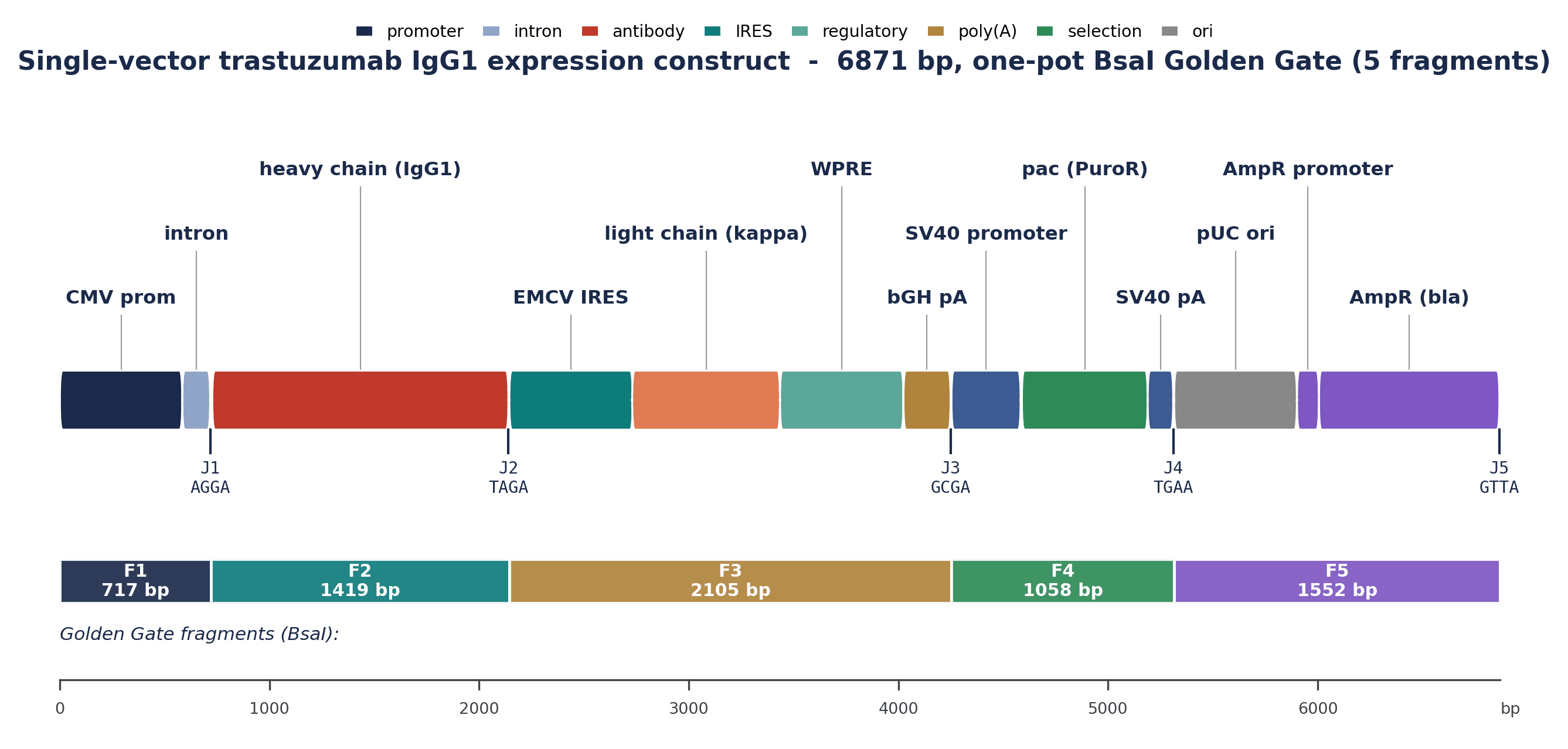
| Fragment | Payload | Junction QC |
|---|---|---|
| F1 | 5'UTR + signal peptide | PASS |
| F2 | IgG1 heavy chain (trastuzumab VH + IgG1 constants) | PASS |
| F3 | EMCV IRES + light chain (trastuzumab VL + κ constants) | PASS |
| F4 | Puromycin resistance cassette | PASS |
| F5 | Backbone (ori, AmpR) | PASS |
Approach
Five-fragment architecture
Defined the architecture: CMV promoter → signal peptide → IgG1 heavy chain (trastuzumab VH + IgG1 constants) → EMCV IRES → light chain (trastuzumab VL + κ constants) → puromycin resistance cassette, on a 6,871 bp backbone, assembled in one pot.
CHO-K1 codon optimization with type IIS site avoidance
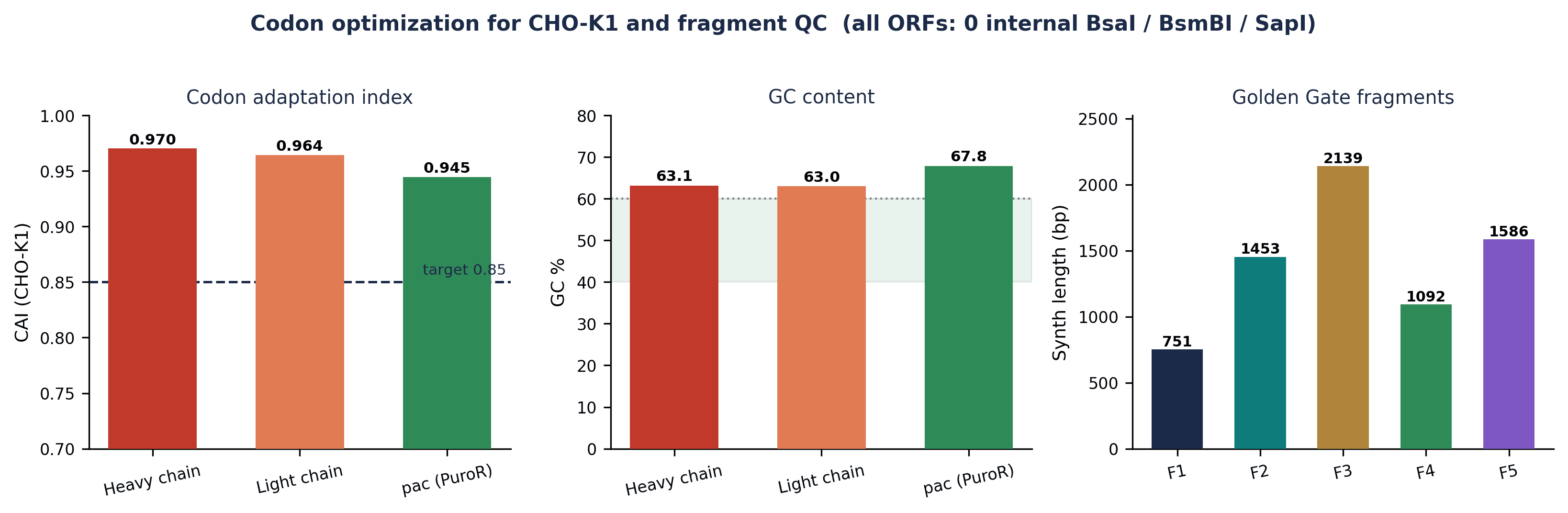
Optimized both chains and the puromycin marker for CHO-K1 (Cricetulus griseus, taxid 10029) — final CAI 0.945–0.970, all above the 0.85 target. Hard constraint: zero internal BsaI / BsmBI / SapI sites across every fragment. Achieved on the optimization step itself, not as a retry.
Fusion-site overhang selection
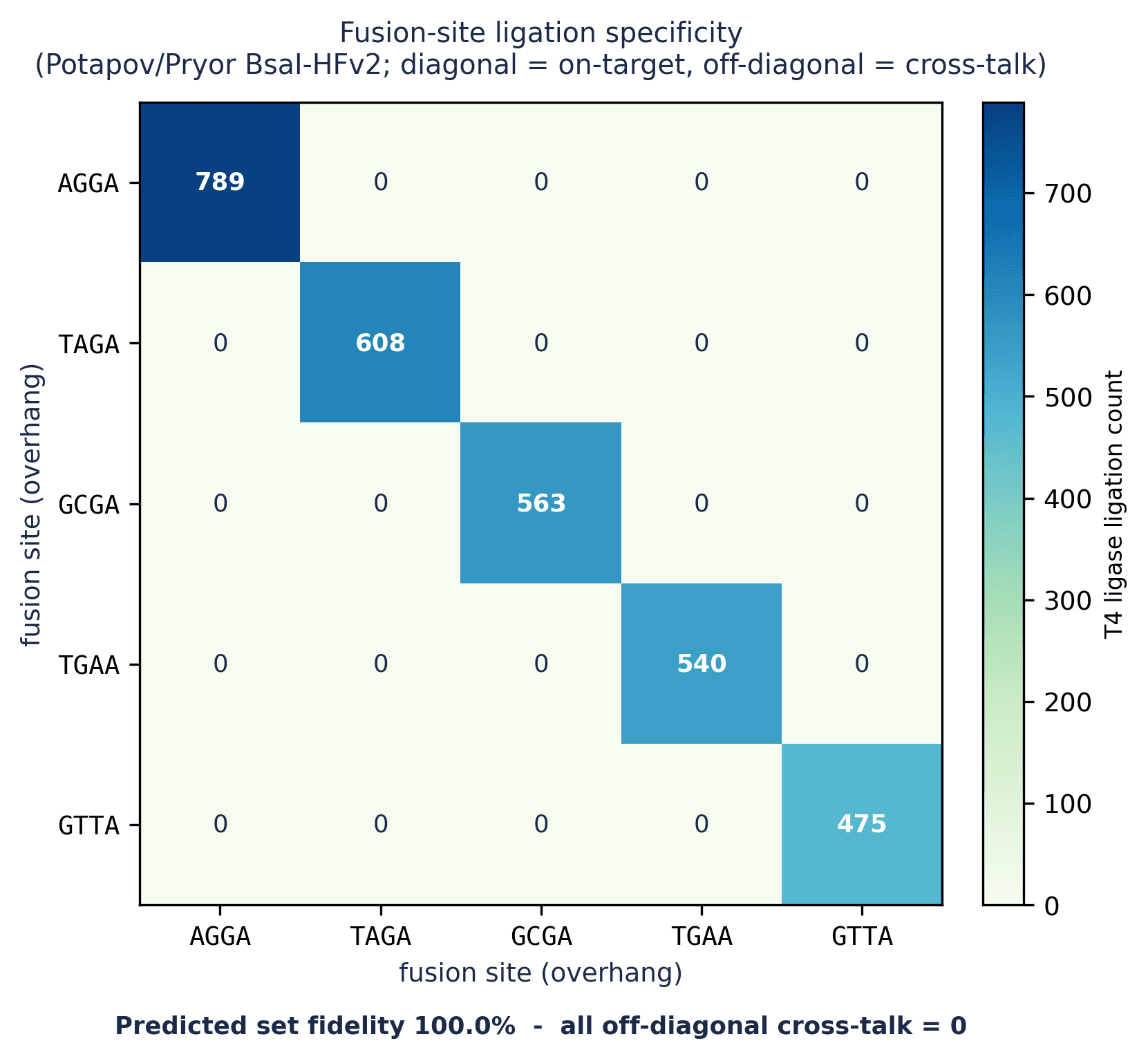
Selected five fusion-site overhangs from the Potapov 2018 high-fidelity set. Screened pairwise for orthogonality (no cross-ligation predicted), palindrome-free, and validated calibration against the Pryor 2020 MoClo 11-set reference. Fidelity estimator: junction-level (one strand each), off-targets over both strands.
Junction colony-PCR primers
Designed five colony-PCR primer pairs anchored across each fragment junction. Tm-matched within ±0.5 °C, primer3-scored, and screened by isPcr against the CHO-K1 PICRH-1.0 reference genome — zero spurious host amplicons.
Figures from the report
Deliverables
6-page report with the construct schematic, fragment-level QC tables, codon optimization summary, overhang orthogonality matrix, and an honest caveats section (heavy:light IRES balance is the one consideration to monitor empirically).
The full 6,871 bp construct as an annotated GenBank file — every feature (promoter, signal peptide, CH/CL domains, IRES, selection marker, ori) labelled. Drop-in for Benchling or SnapGene.
Every fragment, oligo, primer pair, and overhang sequence in order-ready format with Tm, thermodynamics, and QC flags.
All construct parts, fragments and primers as plain FASTA for synthesis and ordering.
The complete reproducible run — input/, scripts/ (numbered pipeline), output/, intermediate JSON, BLAST and isPcr results, and tool versions.
Outcome
A 6,871 bp single-vector trastuzumab construct that assembles in one BsaI Golden Gate reaction with zero internal type IIS sites, mutually orthogonal Potapov-set overhangs, and CHO-K1-specific junction primers — delivered in roughly two hours against an industry-standard 2–3 week internal design cycle.
Want a case study like this for your team?
Request access and we'll run a task that matters to you — typically delivered within 24 hours.
Request Access