
TP53-mCherry endogenous reporter
An endogenous fluorescent reporter for TP53 — primary and backup guides cross-validated across three independent off-target tools, with a complete HDR donor and genotyping primer set.
Full reproducibility folder — input, scripts, output, intermediate data, BLAST results, tool versions. Re-runnable end-to-end.
The brief
The verbatim prompt sent to the agent. Real prose, not a polished spec.
We want to endogenously tag TP53 with mCherry in HEK293T so we can do
live-cell imaging of p53 dynamics under genotoxic stress. C-terminal fusion,
SpCas9, HDR donor.

Need:
- guides at the TP53 stop codon, cross-validated across at least 2 tools
  (had a previous design fail in the lab because of a pseudogene match
  none of us caught with a single tool)
- HDR donor with ~800 bp homology arms each side, GS linker before mCherry,
  PAM-blocking silent mutations so the donor doesn't get re-cut
- junction validation primers for genotyping (5' and 3' anchored outside
  the homology arms) plus an internal Sanger primer pair across the insert
- full off-target report for the top guides

Cell line is HEK293T. Reference TP53 NM_000546.6 on GRCh38. The mCherry
should be codon-optimized for human and contain no internal BsaI / BsmBI
sites since we may re-clone it later.
Context
A cell-biology collaborator wants an endogenous mCherry knock-in at the TP53 C-terminus in HEK293T for live-cell imaging of p53 dynamics under genotoxic stress. The previous internal design failed in the lab because a pseudogene match was missed by a single-tool guide screen — so the brief explicitly asks for cross-validated guides at the stop codon, an HDR donor with optimized homology arms, junction-validation primers, and a complete off-target report.
Deliverable preview
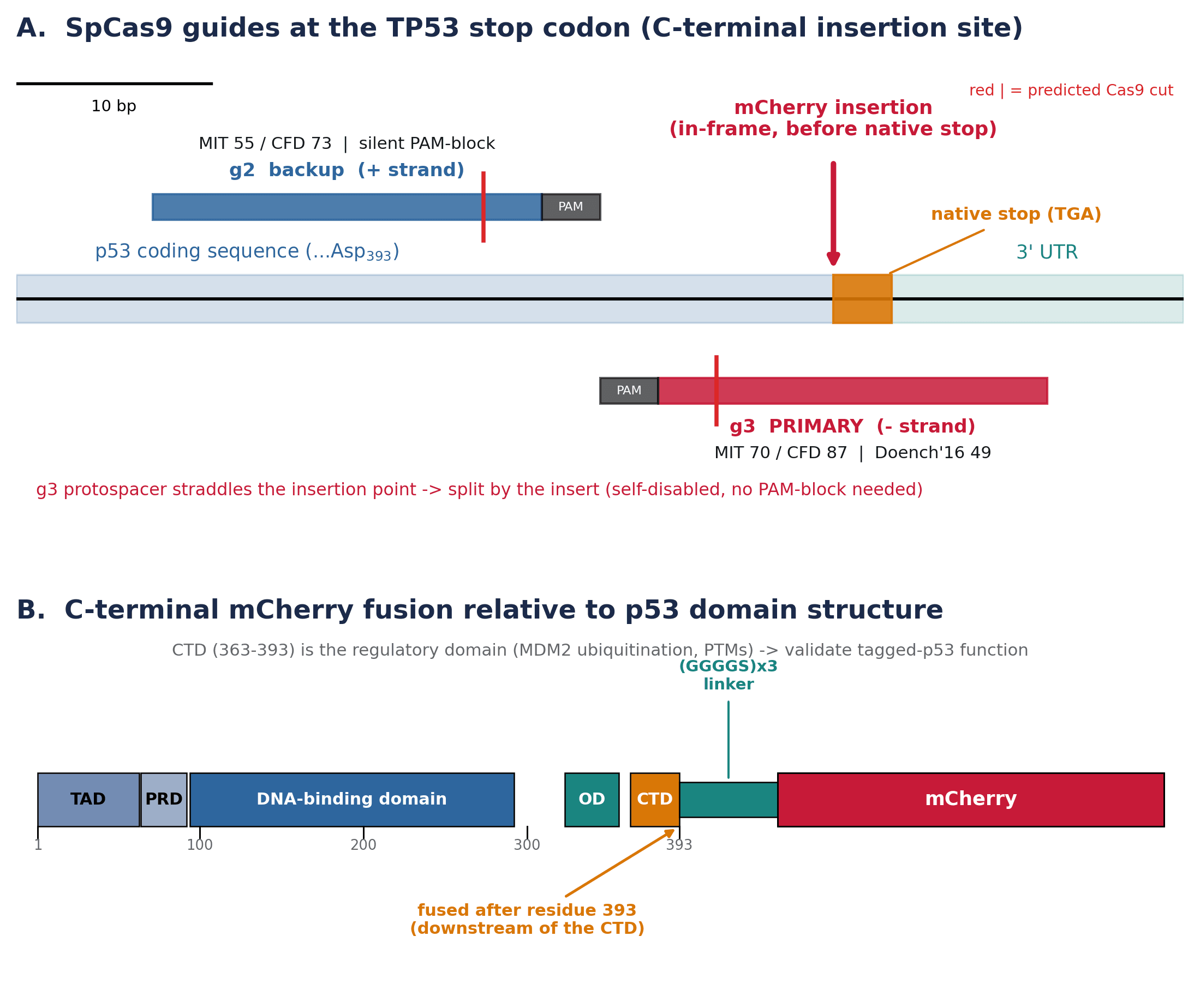
| Guide | Role | Cut→Insert (bp) | Off-target (≤1 MM) |
|---|---|---|---|
| g3 | primary | 6 | 0 |
| g2 | backup | — | 0 |
Approach
Locus retrieval and stop-codon window definition
Pulled canonical TP53 (NM_000546.6) and surrounding genomic context from Ensembl REST against GRCh38. Located the exon 11 stop codon and defined a ±25-nt design window for fusion-compatible cuts.
Three-tool guide cross-validation
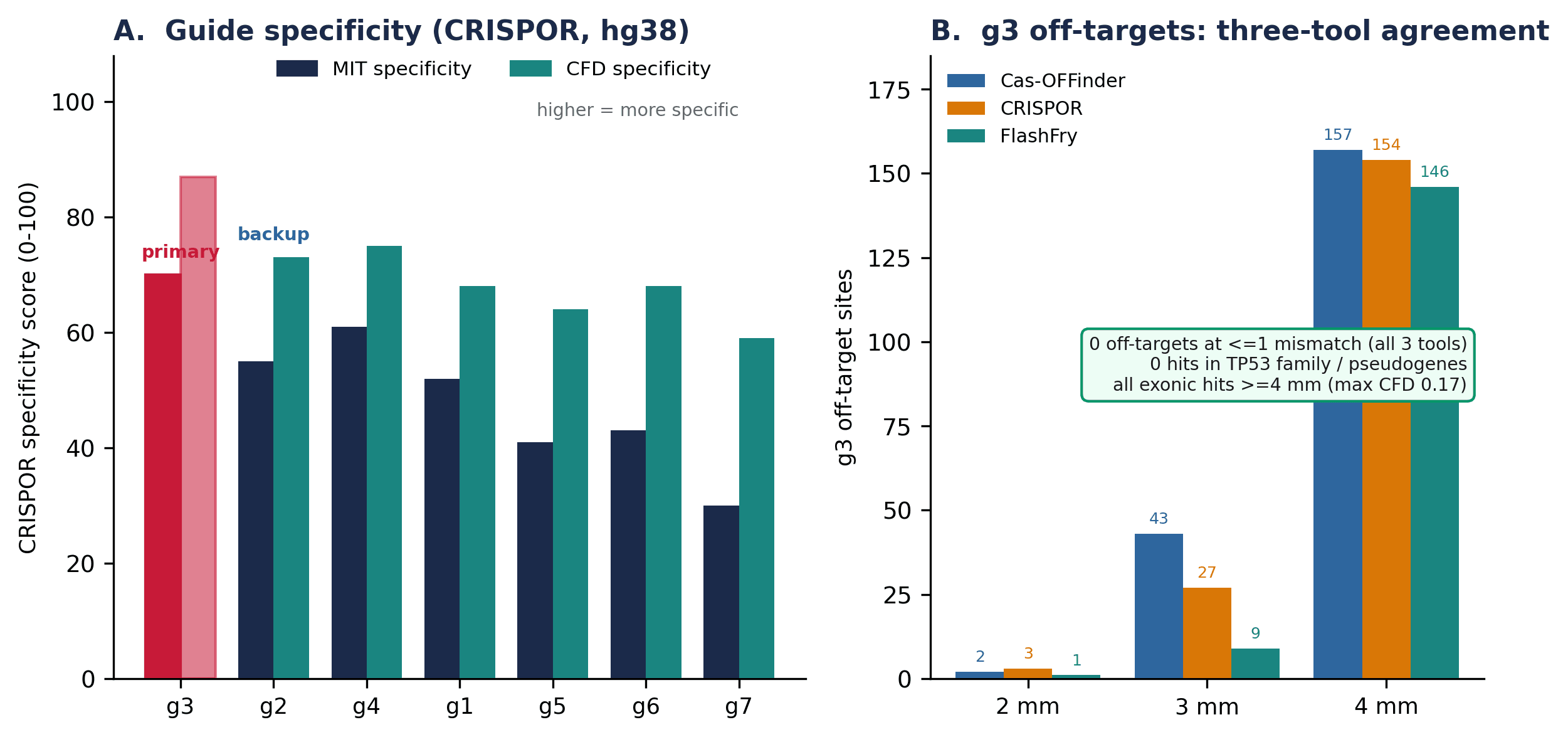
Generated guide candidates and screened them in parallel through Cas-OFFinder v2.4.1, CRISPOR v5.2 and FlashFry. Both surviving guides (primary g3, backup g2) show zero off-targets at ≤1 mismatch, no hit in any TP53 pseudogene, and no hit in any p53-family gene — directly clearing the failure mode that broke the previous internal design.
HDR donor design
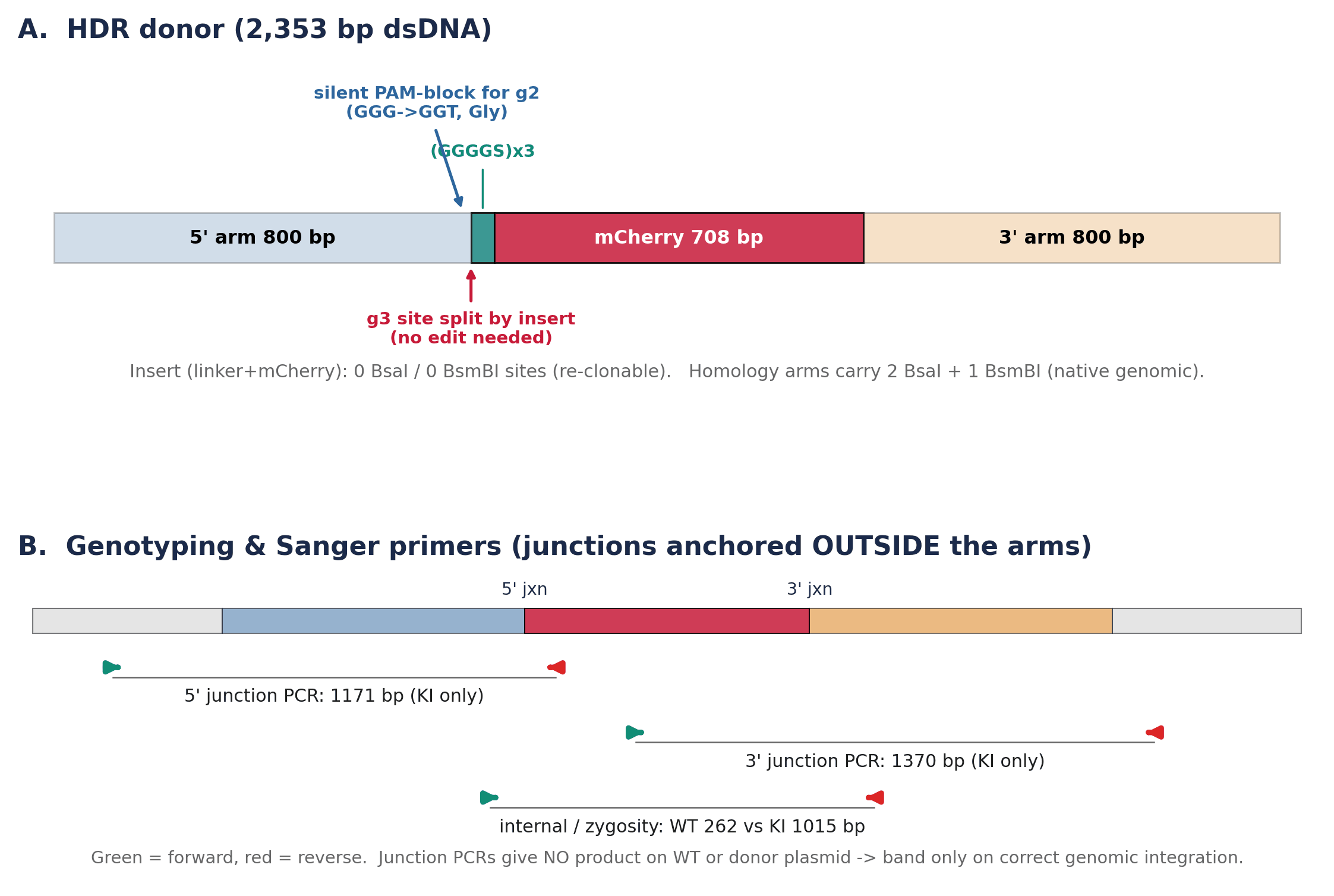
Constructed a 2,353 bp donor: 800-bp 5' homology arm + (GGGGS)x3 linker + a 708-nt mCherry codon-optimized for Homo sapiens (DNAChisel) with no internal BsaI/BsmBI sites + 800-bp 3' homology arm. The primary guide is intrinsically re-cut-immune because its protospacer is split by the insertion; the backup guide receives a single synonymous PAM-blocking mutation.
Genotyping primers
Designed two junction-validation pairs (5' and 3') anchored outside the homology arms, plus an internal pair across the mCherry insert for clone-level zygosity calling. Tm-matched within ±0.6 °C, primer3-scored, and BLAST-checked for genome uniqueness.
Figures from the report
Deliverables
6-page report: locus context, guide ranking with three-tool off-target evidence, HDR donor architecture, genotyping primer set, methods, and an honest caveats section (including the SV40 large-T-antigen biology of HEK293T).
Guide sequences, donor architecture parameters, all primer thermodynamics, and the per-tool off-target evidence — machine-readable.
The donor cassette, codon-optimized mCherry, and all genotyping primers — order-ready.
The complete reproducible run — input/, scripts/ (numbered pipeline), output/, intermediate JSON, BLAST results, and tool versions. Re-runnable end-to-end.
Outcome
Two guides cleared by three independent off-target tools, a 2,353 bp HDR donor with intrinsic re-cut immunity on the primary guide, and a complete genotyping primer set — delivered in roughly an hour, against the ~2-week internal cycle the previous failed design took to surface its pseudogene problem.
Want a case study like this for your team?
Request access and we'll run a task that matters to you — typically delivered within 24 hours.
Request Access