
NSCLC hotspot multiplex ddPCR panel
A multiplex ddPCR panel for six NSCLC driver alterations from cfDNA — designed, QC'd, and channel-mapped for both Bio-Rad QX200 and QX600.
Full reproducibility folder — input, scripts, output, intermediate data, BLAST results, tool versions. Re-runnable end-to-end.
The brief
The verbatim prompt sent to the agent. Real prose, not a polished spec.
Looking to set up a multiplex ddPCR panel for NSCLC driver mutations
from cfDNA - Bio-Rad QX platform. Want to cover the actionable hotspots
in one or two reactions so we can run liquid biopsies efficiently.

Hotspots:
- KRAS G12C (c.34G>T) and G12D (c.35G>A)
- EGFR L858R (c.2573T>G) and T790M (c.2369C>T)
- BRAF V600E (c.1799T>A)
- EML4-ALK fusion, variant 1 (E13;A20)

Plus a wild-type reference for each gene so we can calculate allele
fractions. Pick the right discriminatory strategy per target (ARMS,
LNA-blocking probe, or hydrolysis-probe SNP discrimination - your call,
just justify it in the report).

The make-or-break QC step is multiplex compatibility - primer-dimer and
probe-dimer screening across the full panel, Tm matching, no homopolymer
artifacts. Flag anything borderline rather than forcing it through.

Need a channel-layout plan for both QX200 (2 channels) and QX600
(6 channels), in-silico specificity checks against the human transcriptome
and gnomAD common SNP positions under the probes, and synthetic gBlock
sequences for each mutant and WT target ready to order. Final report
should include the LoB/LoD validation plan.
Context
A diagnostic lab developing a liquid-biopsy workflow wants to detect the six actionable NSCLC driver alterations (KRAS G12C/G12D, EGFR L858R/T790M, BRAF V600E, and EML4-ALK v1) from cfDNA in one or two reactions on the Bio-Rad QX platform. The make-or-break QC is multiplex compatibility — cross-dimers, Tm matching, homopolymer artifacts — and the brief asked for channel layouts for both QX200 and QX600, paralog and SNP specificity checks, synthetic gBlock controls, and a CLSI EP17-aligned LoB/LoD validation plan.
Deliverable preview
| Target | Variant | Strategy |
|---|---|---|
| KRAS | G12C / G12D | Competitive WT/MUT hydrolysis probes |
| EGFR | L858R / T790M | Competitive WT/MUT (degenerate base at rs1050171) |
| BRAF | V600E | Competitive (BRAFP1 pseudogene designed out) |
| EML4-ALK | v1 (E13;A20) | Junction-spanning probe (RT-ddPCR) |
Approach
Target retrieval and strategy choice
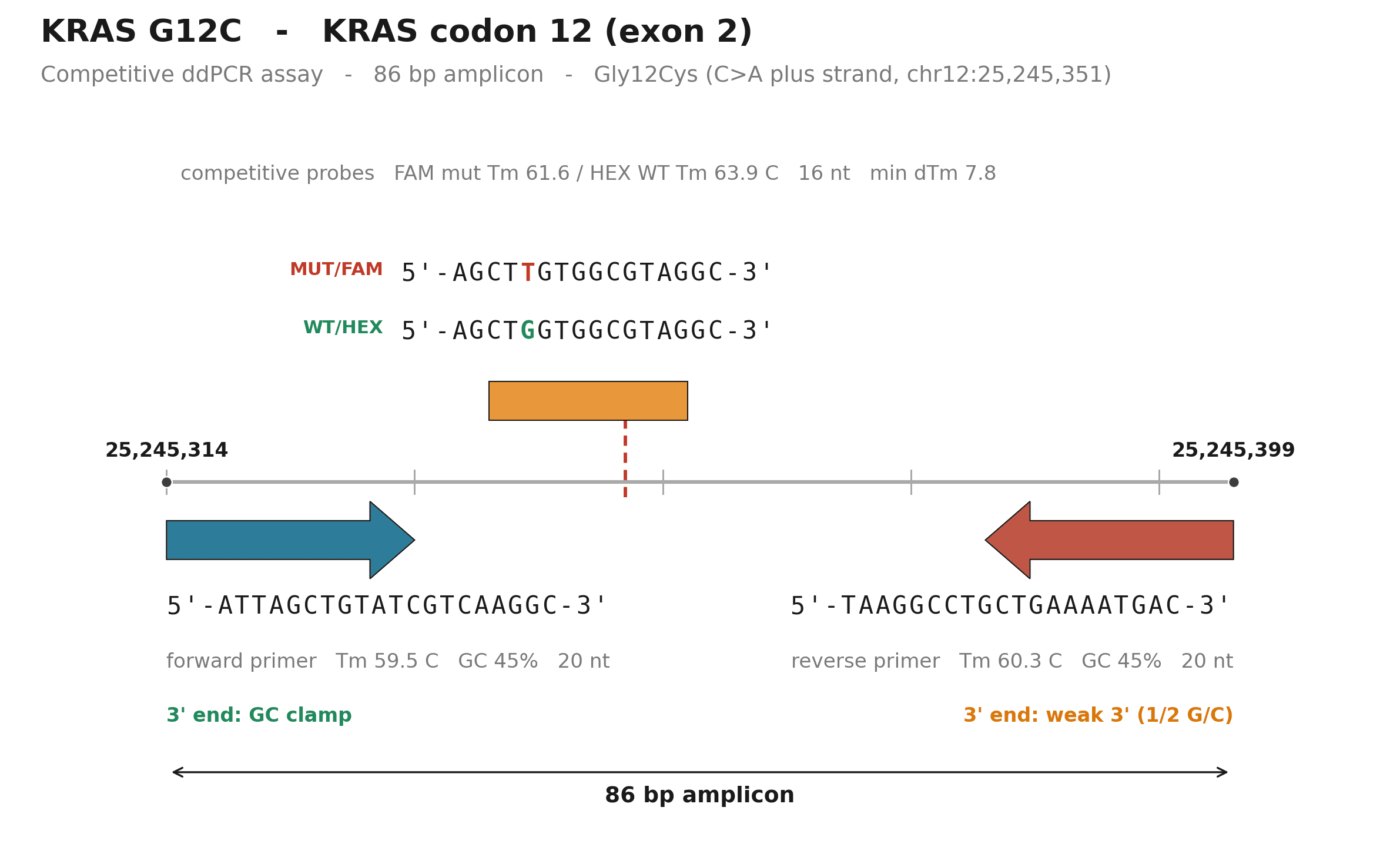
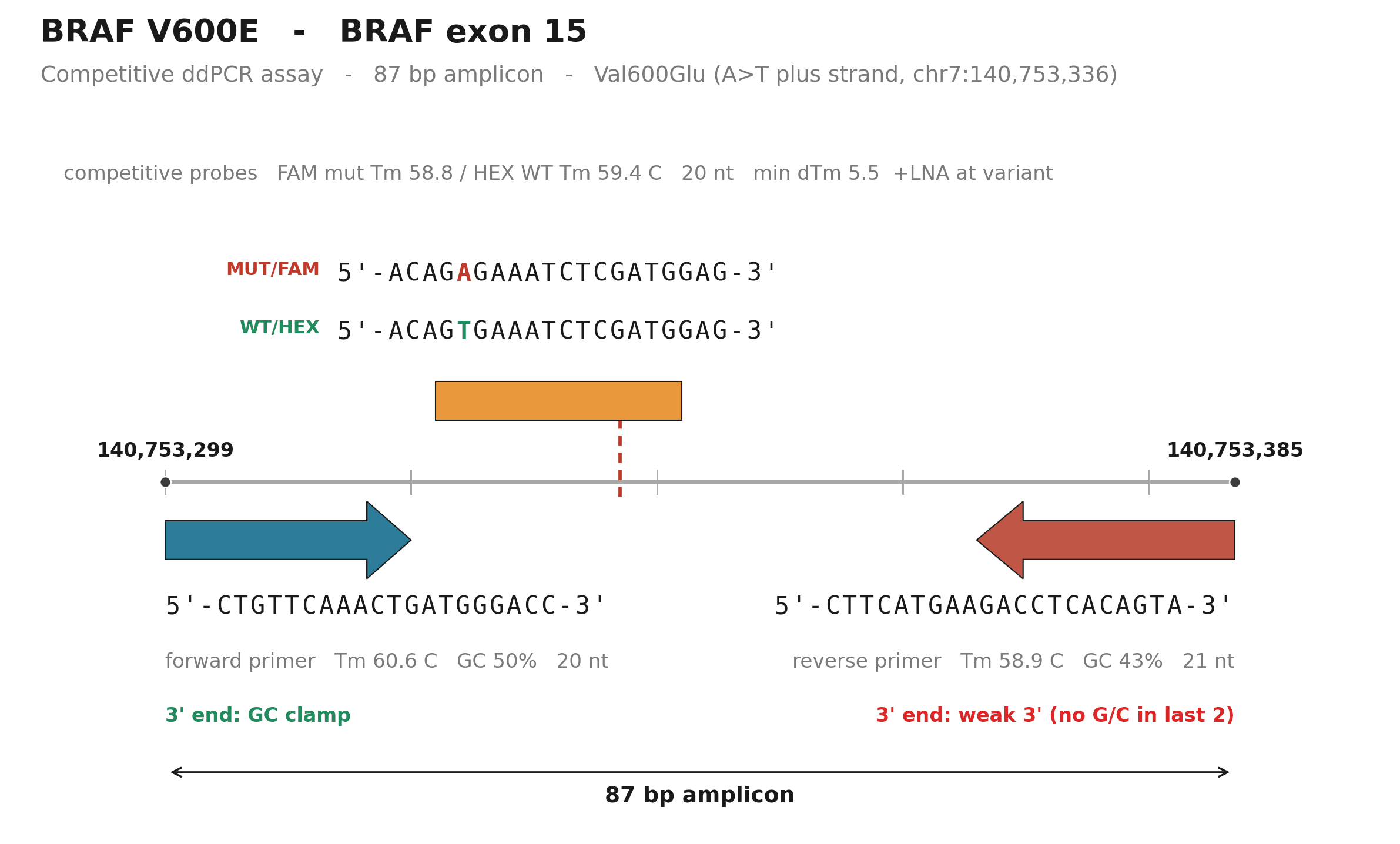
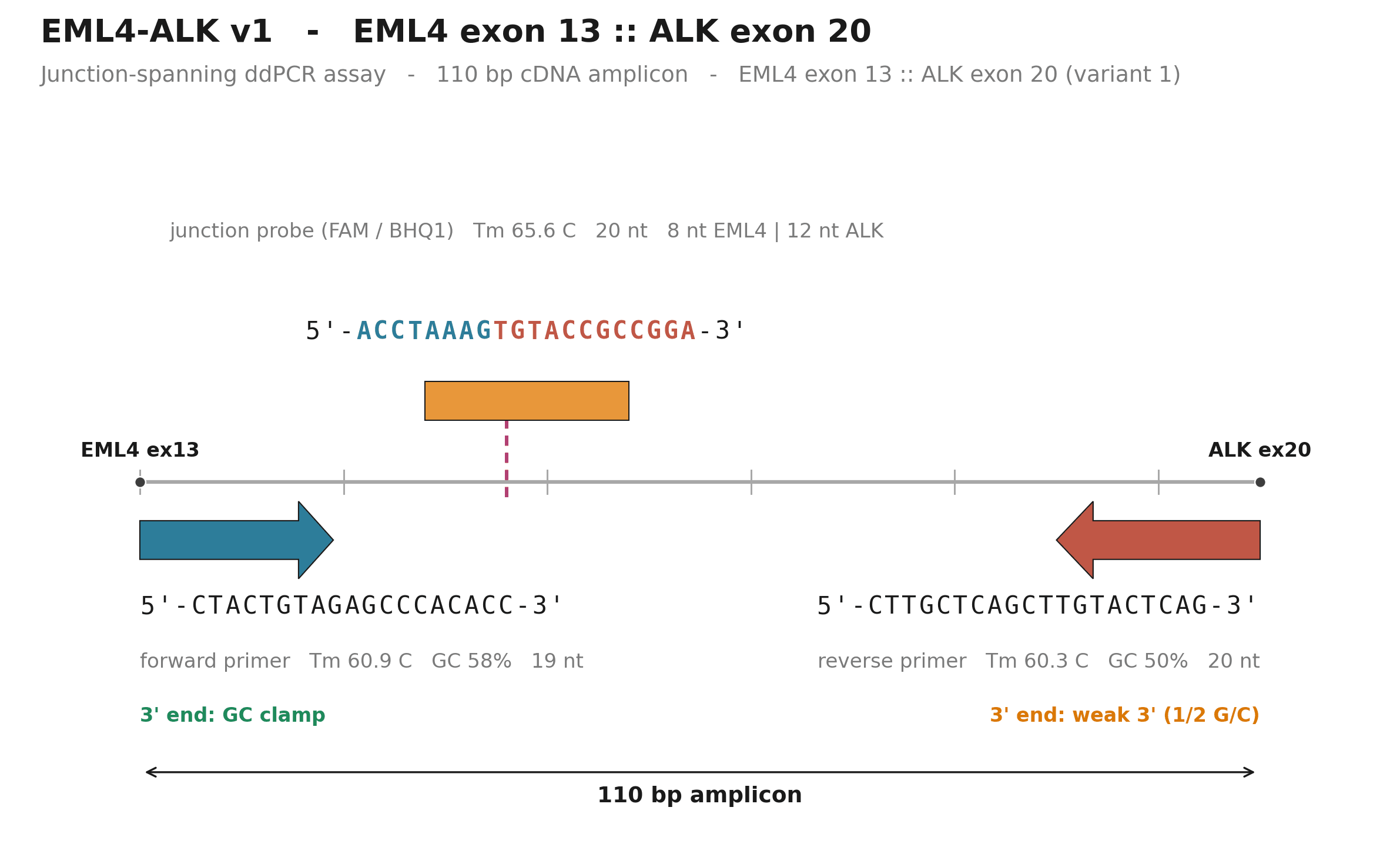
Retrieved genomic loci for KRAS, EGFR, BRAF and the EML4-ALK v1 (E13;A20) junction from Ensembl. Chose competitive WT/MUT hydrolysis probes for the five point mutations (allele discrimination at the probe level) and a junction-spanning probe for the EML4-ALK fusion — with RT-ddPCR input flagged in caveats since the fusion's genomic breakpoints are patient-specific.
Per-target oligo design with specificity hardening
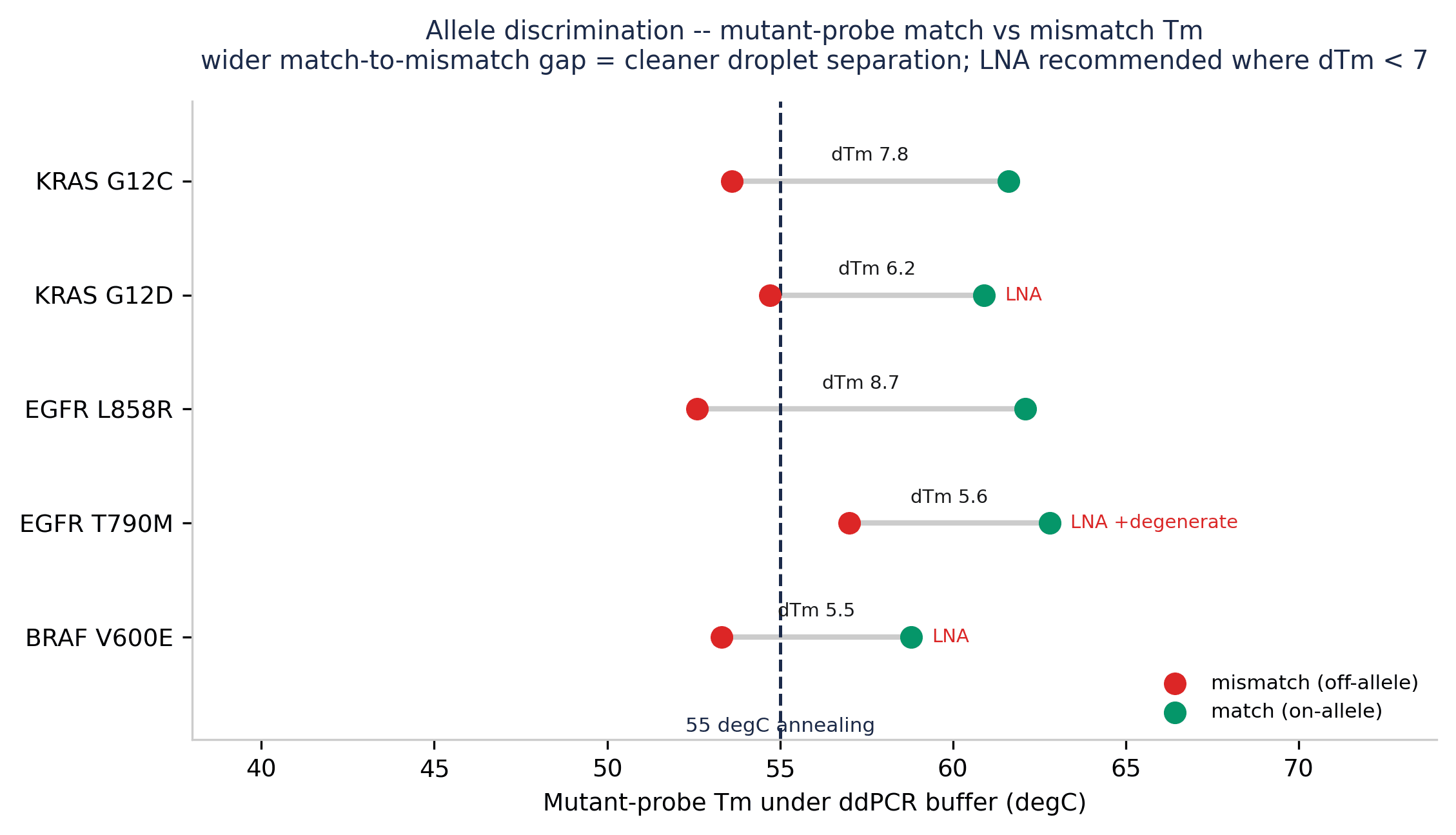
Designed primer/probe sets for each target. Designed out the BRAFP1 pseudogene so it cannot dilute the BRAF allele fraction. Neutralised rs1050171 (~56% population frequency) under the EGFR T790M probe with a degenerate base so the assay works in either genotype. Screened all primers against KRAS/NRAS/HRAS paralogs.
Multiplex compatibility QC
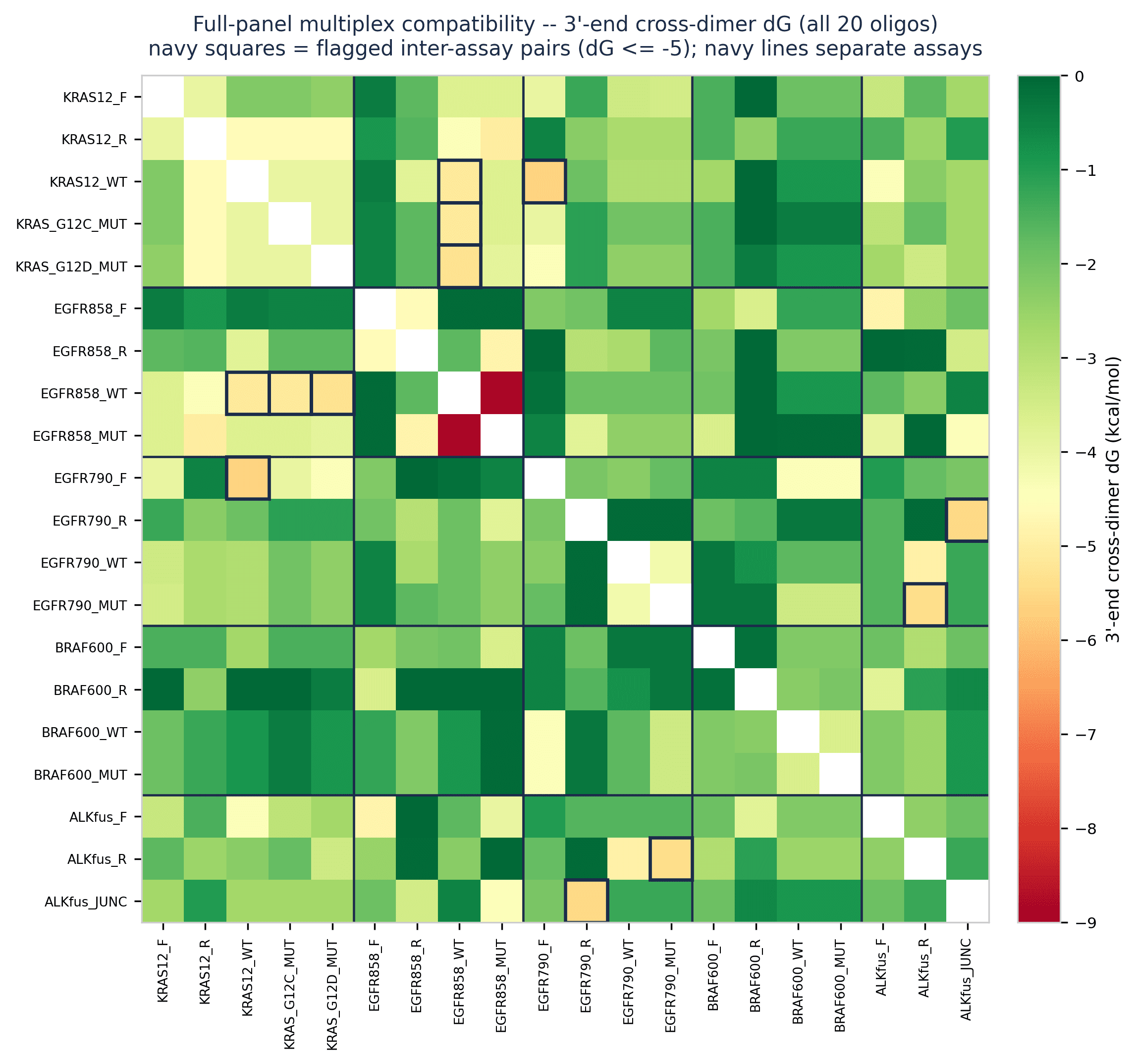
Pairwise cross-dimer screening across all 20 oligos at Bio-Rad annealing temperatures. Tm matched within the multiplex window. No two assays' primers cross-dimer below −5 kcal/mol. One intra-assay liability surfaced honestly: the EGFR L858R competitive probes form a strong cross-dimer from a palindrome intrinsic to the locus — flagged in caveats for empirical validation with an LNA-shortened probe.
Channel layout, controls, and LoB/LoD plan
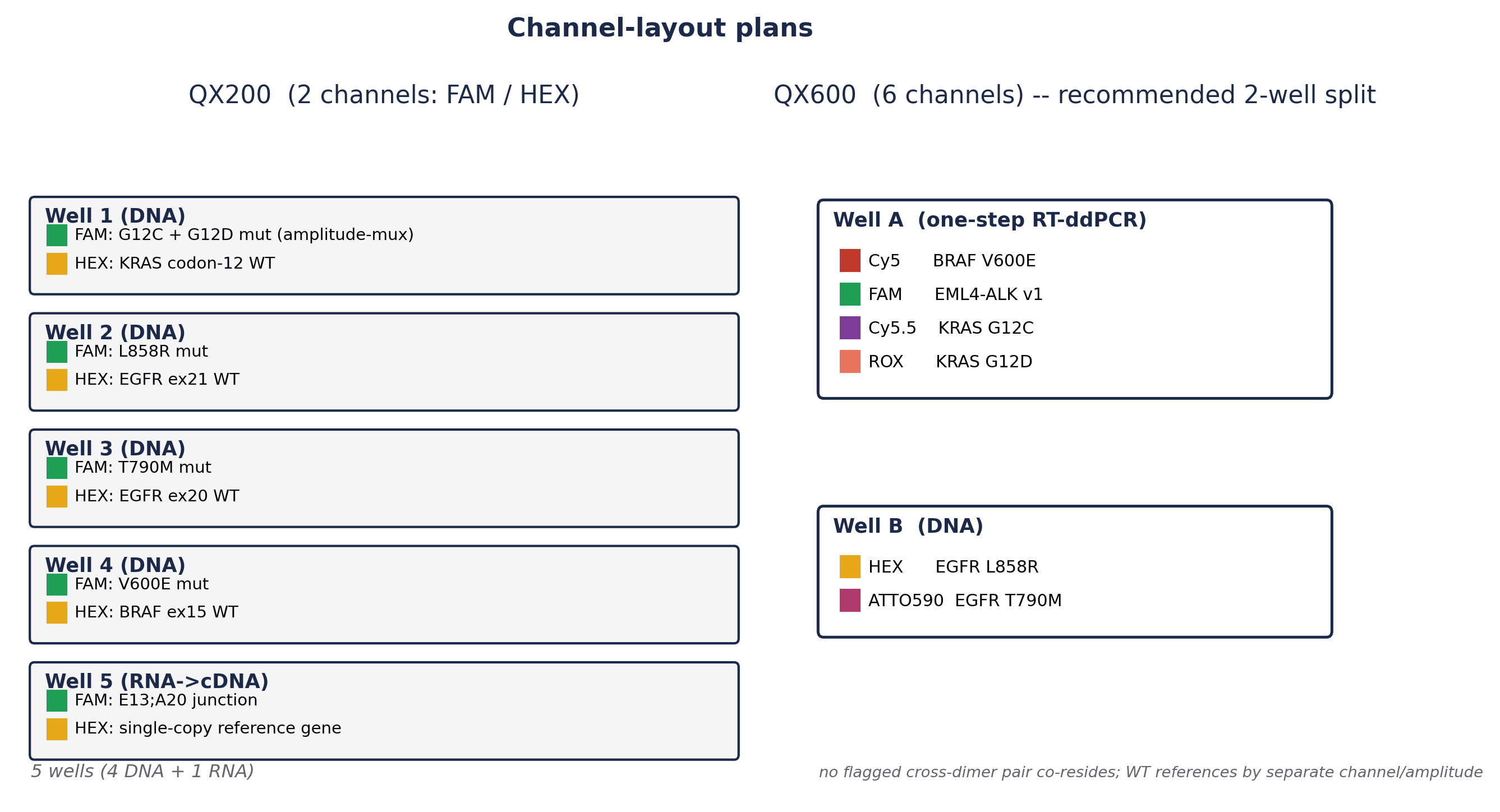
Channel-layout plans for both QX200 (2 channels, allele-fraction model) and QX600 (6 channels, with cross-dimer pairs deliberately split across wells). Ten synthetic gBlock control templates (5 mutant + 5 WT) ready to order. CLSI EP17 LoB/LoD plan with target MAF of 0.1–0.5% and a UDG/dUTP carryover-prevention recommendation for the wet-lab handoff.
Figures from the report
Deliverables
14-page report: per-target oligo design with amplicon schematics, allele-discrimination evidence, full-panel cross-dimer matrix, paralog + gnomAD-SNP specificity, QX200 + QX600 channel layouts, synthetic-control sequences, restriction-enzyme compatibility, and the CLSI EP17 LoB/LoD validation plan.
Every oligo, gBlock control, dimer score, Tm, channel assignment, and specificity flag in machine-readable form.
All 20 oligos and 10 synthetic gBlock control sequences, order-ready.
The complete reproducible run — input/, scripts/ (numbered pipeline), output/, BLAST + isPcr databases, intermediate JSON, and tool versions.
Outcome
Six driver alterations covered across two Bio-Rad QX platforms, every primer pair genome-specific (pseudogene and paralog cross-reactivity actively designed out), the one intra-assay multiplex liability flagged honestly for the bench — delivered in roughly two hours against the 3–4 week internal design cycle this panel would otherwise take.
Want a case study like this for your team?
Request access and we'll run a task that matters to you — typically delivered within 24 hours.
Request Access