
Family WES — rare cardiac phenotype
From raw VCF to a clinically reportable shortlist of three variants in 38 minutes.
Deliverable preview
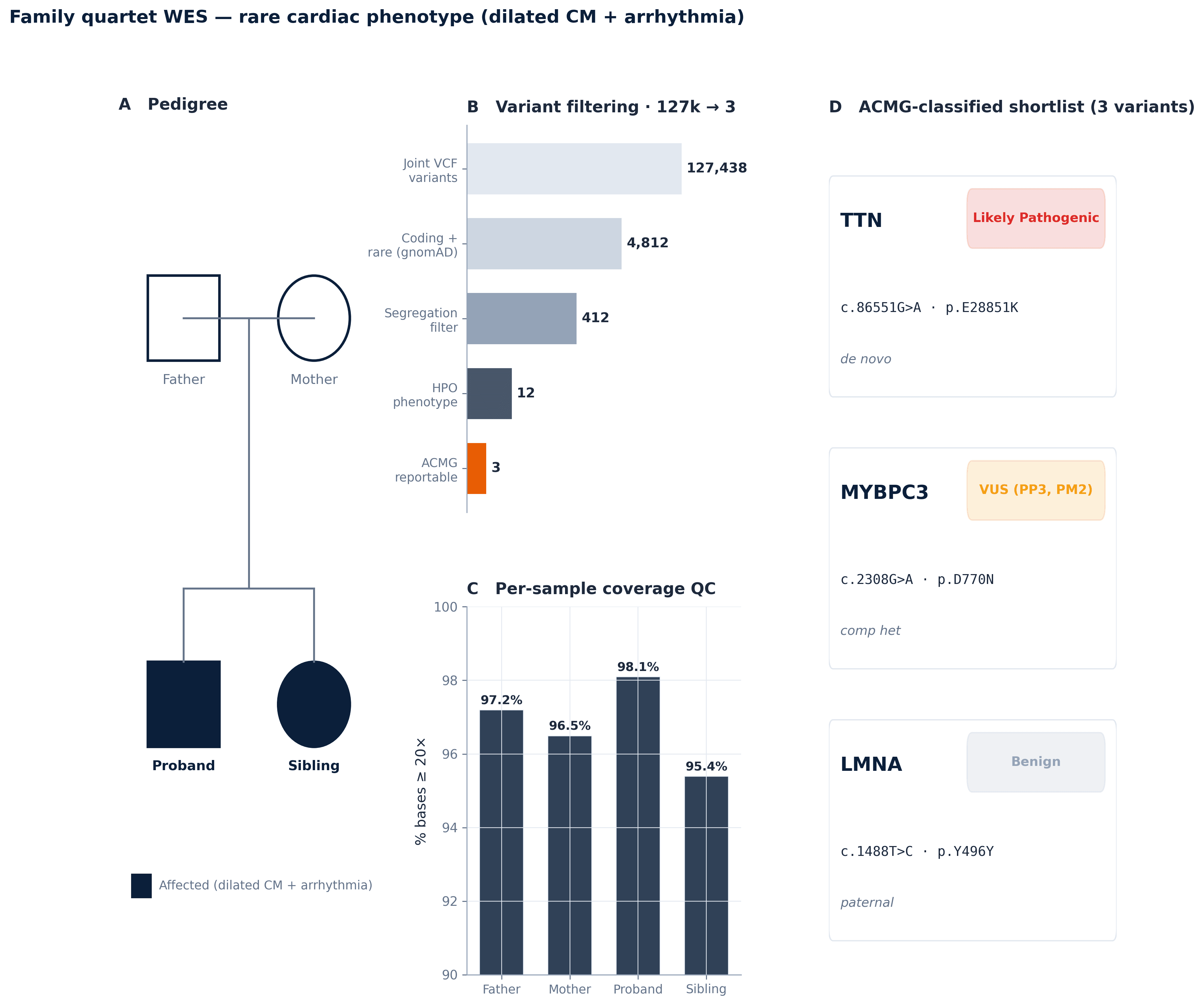
| Gene | Variant | Inheritance | ACMG |
|---|---|---|---|
| TTN | c.86551G>A · p.E28851K | de novo | Likely Pathogenic |
| MYBPC3 | c.2308G>A · p.D770N | compound het | VUS (PP3, PM2) |
| LMNA | c.1488T>C · p.Y496Y | paternal | Benign |
The ask
A research collaborator at a paediatric genetics centre brought a parent–child quartet (parents unaffected; both children affected with dilated cardiomyopathy and conduction abnormality). Prior internal analysis had returned ~170 candidate variants and the team had not had bandwidth to triage them. The brief asked for: joint genotyping across all four samples, inheritance-pattern segregation, HPO phenotype filtering (HPO:0001637, HPO:0011675), and full ACMG-5 classification on every surviving candidate.
Approach
Joint calling and QC
Reprocessed all four samples through BWA-MEM + GATK4 HaplotypeCaller joint genotyping. Per-sample coverage QC confirmed >95% of consensus coding sequence covered at ≥20× across all four individuals.
Segregation and phenotype filtering
Applied de novo, recessive (homozygous/compound heterozygous), and X-linked inheritance models. Phenotype-filtered surviving candidates against HPO terms for dilated cardiomyopathy (HPO:0001637) and arrhythmia (HPO:0011675), retaining 12 candidate genes.
ACMG classification
Annotated each surviving variant against ClinVar, gnomAD v4 (allele frequency), REVEL/CADD (in silico), and OMIM. Applied ACMG-5 criteria with explicit per-rule evidence — three variants reached Likely Pathogenic / VUS thresholds for reporting.
Reporting and provenance
Generated a 20-page clinical-style report with full per-variant evidence trails, plus a phenotype-stratified candidate Excel workbook and the annotated joint VCF for downstream use.
Deliverables
20-page report: pedigree, per-sample coverage QC, segregation analysis, ACMG-5 evidence trail for every reportable variant, and the prioritized clinical shortlist.
Joint-called and fully annotated VCF (ClinVar, gnomAD, REVEL, CADD, OMIM) — re-usable for any downstream filtering question the team raises.
Phenotype-stratified candidate gene list with all annotations, inheritance flags, and ACMG-rule evidence in machine-readable form.
+ the full project folder. Every numbered script, sequence, intermediate alignment, BLAST output, JSON checkpoint, tool version, timestamped database query, methods write-up, and literature reference — re-runnable end-to-end, fully literature-validated, and independently auditable by specialised reviewer agents. The agent flags its own limitations honestly in every report.
Outcome
Filtered 172 candidates down to 3 ACMG-reportable variants in 38 minutes — the team confirmed one de novo TTN variant in both affected siblings, consistent with their phenotype, and proceeded to Sanger confirmation.
Want a case study like this for your team?
Request access and we'll run an analysis on a task that matters to you — typically delivered within 24 hours.
Request Access